
6 Things I Learned While Editing My Novel
My first time working through a developmental edit

I keep refreshing my email, from fear and excitement, but mostly out of morbid curiosity.
From the time that this is posted, I only have 3 days until the deadline to receive official feedback from my editor on my manuscripts current state is over. Is my novel in a coma? Maybe in rehab? Perhaps it’s on life support.
All I know is that when I sent it off roughly 3 months ago, I believed it to be the best version of my novel I could craft into being. I also knew it wasn’t the best it could be, but by golly, it was the closest it’s ever been.
So frankly, I’m excited to see what my editor loved, if she sees what I see on a conceptual level. But also, to see what’s wrong, what I can dive into and iron out, what I can make better. I love this book and I want others to love it too. But there’s work to be done.
These three months between releasing my book like a carrier pigeon to the unknown wilds of professional editors and awaiting that pigeon’s safe return has been different than I anticipated. I’m sure I’ll prattle on about why eventually, but here’s what you need to know: I planned to be very productive during this time and have decidedly not been. Apparently, after hardcore editing my novel on a conceptual level for 4 months, my brain needed a break. But this break has also helped me look back and hopefully glean a few things for the next time I edit.
Which could start in T-minus 3 days.
Before my brain forgets every ounce of my experience, I want to solidify it in my mind by sharing what I learned from editing my novel (as a first timer).
The process doesn’t have to make sense
If you are in writing circles online, there is a lot of talk about famous authors’ processes. How to write like Stephen King, why Agatha Christie’s morning routine is the best, if Shakespeare had a Substack, here’s what he’d do with it, etc. Advice like this has to make sense enough to be implemented by anyone who stumbles across it.
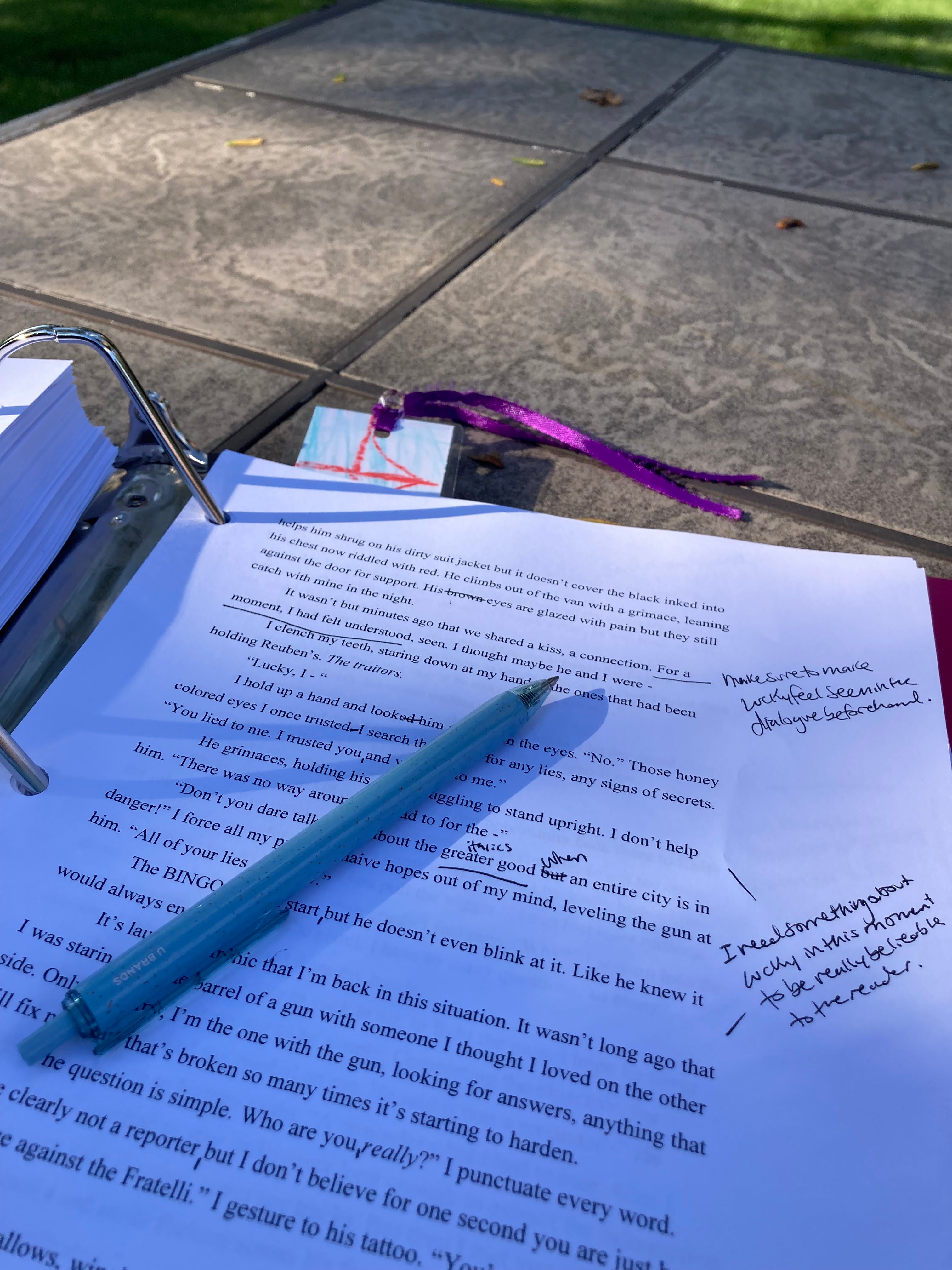
I finally understood what editing on a developmental level meant, but now I had to find a way to make it happen. I thought my process needed to look a certain way, that every step had to make sense. Nope, it just had to work.
I already had my whole manuscript printed out so I just dove right in, reading and noting anything I liked or didn’t, asking questions to myself. As I read, I created index cards of each chapter, breaking them down into scenes with the beginning and ending emotion. I already knew the big picture of the story, but it was super helpful to learn what the scenes were doing and if they were successful. When I cracked open the document, I started in order but soon found myself needing to add chapters and follow certain characters’ arcs. It worked well to go back and forth in the story, until it was all complete. I’m not sure why it was a successful method, but it worked for this book, with this writer, at this time and that’s all that mattered.
Edits are like
ogres…onions… tiramisu
I once believed you had to write and edit in a linear fashion, straight through, no returns. Which as you can imagine, was quite difficult to put into practice. A story is constantly shifting and changing, it needs to be sifted through, not bulldozed. It is created in layers, like a delicious dessert built up on your plate.
There’s only so far that metaphor can go, but the reality is, you can edit in layers. You don’t have to just blanket edit it all and hope you catch everything. It’s something I learned a little late in the game as I tried (unsuccessfully) to line edit a chapter AGAIN when what it really needed was side character motivation and stronger dialogue to move the story along. Not everything has to be perfect or even right to keep going. I’m learning to work in a big picture and then narrow it all down. I will still change a comma here and there because I can’t help it. But I had to learn to hold my tiramisu, sorry, novel lightly so the layers could do their thing and support the story.
Do a pass through a scene, a chapter, the whole manuscript. And then do it again and again until it feels right. Don’t stress - it’s just a layer. This is a lesson I am really hoping I can remember as I enter the second concept edit soon.
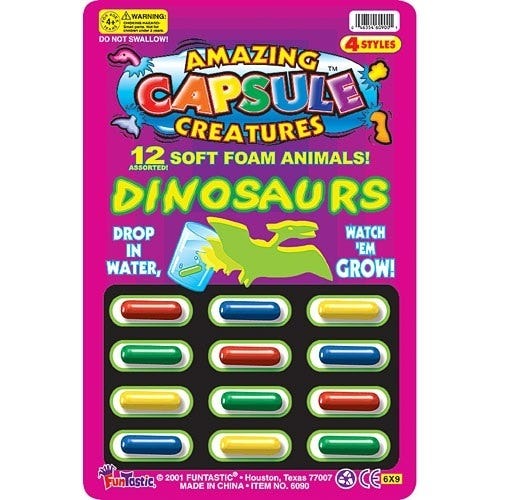
Stories expand like an Amazing Capsule Creature*
When I originally typed “The End” in my WIP, I thought the pages contained all the story it needed. I couldn’t think of more scenes or characters or meaning that I could cram into the pages. But with time and work, I realized that wasn’t true. As I edited, I found gaps and holes that the story was dying to fill in. Some people may call them plot holes, but they are really opportunities to strengthen the book. But instead of all of the holes feeling impossible to fill, I discovered many of them were actually plastic capsules holding a tiny foam dinosaur. You know, the kind you placed in a sink full of water as a kid and got to witness the magic of hatching a little primary colored dinosaur.
So suddenly, by watering my capsule story with time and intention, my story filled out. Thankfully, no dinosaurs made it onto the page, but new characters, new settings, new scenes all popped out. I’m not saying the solution to every plot-hole is to add more and more, of course. But a story that I thought was final and airtight, showed it had room to grow. And boy, did I have fun watching those dinos grow.
Take breaks before you break
I unlocked a new superpower while editing. Gaining super speed or the ability to stop time would have been very helpful for my tight deadline. However, I learned a different power that both scared and excited me: hyperfocus. Call and diagnose it however you want, but when finally got through my long day at work and sat down at the kitchen table to write, hours flew by and I didn’t even notice. Eating, resting, potty breaks? Didn’t even cross my mind. It was me and the page, me and the click-clack of my keyboard.
I truly meant to implement the Pomodoro technique, take breaks, refresh my brain, etc. But bless my poor family because they had to actively remind me to eat, stretch, drink water, and use the bathroom. I had some serious breakdowns working through this book, but they saved me from a whole lot more, had I been doing this alone.
Other writers and artists aren’t joking, please take a break before you break. Your art is worth the effort, but not worth your well-being. Take breaks as you work, but also plan entire days off. Put in the work of giving your brain and body some space from your story. It will thank you later.
Keeping One Singular™ song on repeat to write a scene really does work
I was in the last few days of my deadline, and a particular scene had me going back and forth like a long fencing match. I’d edit a description here, tweak some dialogue here, bouncing between the beginning and the end until all that remained was a gaping hole in the middle of my last chapter. Mind you - it wasn’t the book’s last chapter, but the chapter that chose to be edited last. The one that was holding out emotionally. The one that wouldn’t stop surprising me or stumping me.
So, I did the only thing I could think of. I popped in my earbuds and cranked the tunes until I landed on one song. And then I listened to that one song on repeat. Over and over and over again until the chapter was done. Something about having the same vibe, the same lyrics to create a canvas in my brain to work on, really worked for me. I’ve done this before while drafting, but I’m glad I remembered it for revisions!
You can expect a thank you to Miss Taylor Swift and her song “Father Figure” in my acknowledgements. FYI, the biggest con to this tip: you will screw up your end-of-year music wrapped.
You are allowed to love your book
I’ve heard the advice that if you are willing to write a novel, you better really like the story. You’ll be spending not just hours, but months and years writing and developing it. Writing, rewriting, editing, formatting, selling, on and on. I assumed that at some point the novelty (pun mildly intended) of it all would wear off. That perhaps, most authors saw their books through to publication because they had some sort of an obligation to the story.
I was used to starting smaller form projects and losing interest halfway through - this is something I am working on, promise. So, when I sat down with my novel I had already taken 7 years to write and poke at, I was afraid the magic had worn off. But boy was I wrong. Getting back into the weeds of this story, strengthening the characters and scenes until it started to match the story I actually wanted to tell, was almost addicting. It was satisfying to see progress (I am not saying it wasn’t hard - this was a battle).
I’ve been trying to introduce the Lord into my creative process, praying for His ideas, His guidance as I write. And I really felt Jesus renew my love for this book and help me persevere to the end. I took detours for sure, creating mockup posters and posts in Canva, dreaming of fanart, dropping notes for sequels. Although it was definitely procrastination, some of my creative side quests actually helped in an unexpected way. I just really love my book. And sometimes that looked like typing words or deleting them, or not writing words at all. But you are allowed to love the process, however messy and long and wonderful, because it’s yours.
I’ve refreshed my email multiple times while writing this. Perhaps I will go do it again when I know well that nothing will be there until this coming Tuesday. I’m just so excited to be doing this writer thing.
xoxo,
K.J. Haakenson
*For your edification <3
I love this. So many great and necessary reminders. Im excited for you! 💕